
The method inside Legal Engineering
Backwards, and costly
Most legal engineering conversations start with the system: which model, which workflow, which integration. Design rarely comes up until something isn't working.
That order is backwards, and it's costly.
A legal AI workflow can be legally accurate, technically sound, and still sit unused. Not because the logic is wrong, but because nobody thought about how a corporate associate actually triages a deal inbox at midnight, or why a real estate lawyer quietly stops opening a tool the moment it asks for one extra click before letting them work. Legal engineering builds what a system can do. Legal design decides whether anyone will actually do it.
A method, not a finish
Legal design is not branding, and it's not a nicer interface bolted on at the end. It's a method: understand how the people doing the work actually think, decide, and get interrupted, then build the system around that reality rather than around what's technically elegant. It borrows from human-centred design - interviews, prototyping, testing with real tasks - and applies it to how legal work gets structured, written, and delivered.
Skip that step and the risk doesn't show up immediately. The workflow gets built, the demo goes well, adoption starts strong. Then, a few weeks in, usage quietly drops. Nobody complains, because nothing broke. People simply drift back to the old way, one small friction at a time: an extra field to fill in, a summary format that doesn't match how they report to a partner, a tone that doesn't sound like the firm's own.
What changes when design sits inside engineering
Bringing legal design into legal engineering from day one changes what gets built. Instead of designing for the average user of a generic tool, we design around the specific way a specific team works: how they open a matter, where they cut corners under pressure, what a "good enough" first draft looks like to them. Every prompt, every step in a workflow, every output format becomes an interface decision, not just a technical one.
That's also, not coincidentally, what shortens the productivity dip firms hit when they adopt AI. A tool that fits how people already work needs far less willpower to keep using. The habit holds on its own, without anyone having to push it.
How we do it
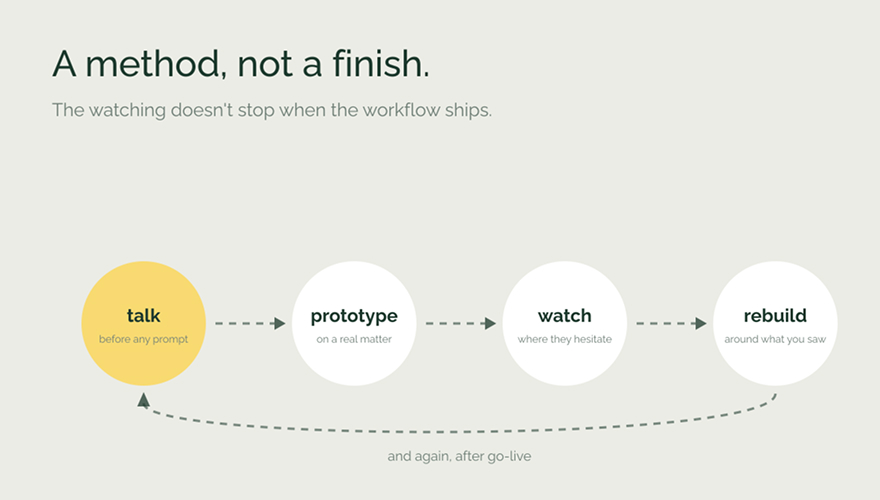
We treat legal design and legal engineering as one process, not two handoffs:
- Talk to the people who will actually use the workflow before a single prompt is written.
- Prototype with them, on a real matter, not a sample document.
- Watch where they hesitate, skip a step, or go around the tool - that's the design brief, not a bug list.
- Rebuild the output format, the review step, or the wording around what they showed you, not around what the process diagram said.
- Keep doing this after go-live. What fits this quarter won't automatically fit the next one, so the watching doesn't stop just because the workflow shipped.
This is what Legal Engineering, forward deployed, actually looks like day to day: not a system handed over once, but a fit that someone keeps tending.
A system that is only capable was never the goal. Getting your team to actually reach for it, every day, is.