in practice.


.png)




.jpg)









.png)















Frequently asked questions
Does Saga support all practice areas?
Saga is practice‑area agnostic: it supports litigation, arbitration, investigations, transactional work, regulatory, employment, and more, because it operates on your documents and legal sources rather than being hard‑coded to one domain.
Does Saga integrate with our existing workflows, or will we need to change how we work?
Saga is designed to plug into existing workflows (e.g. Word, DMS) so lawyers can work where they already are. You don’t need to redesign your entire matter lifecycle; you add Saga as an assistant at key steps (analysis, drafting, review).
How accurate is Saga? Is there benchmarking or validation data?
Saga combines state‑of‑the‑art language models with retrieval from your verified documents and legal sources to keep outputs grounded in real material. We run ongoing benchmarks on standard legal tasks (summaries, clause extraction, drafting) and conduct firm‑specific pilots so you can validate accuracy on your own matters before broad rollout. Accuracy depends largely on use case and the prompts that are used.
Does Saga hallucinate and how is that risk mitigated?
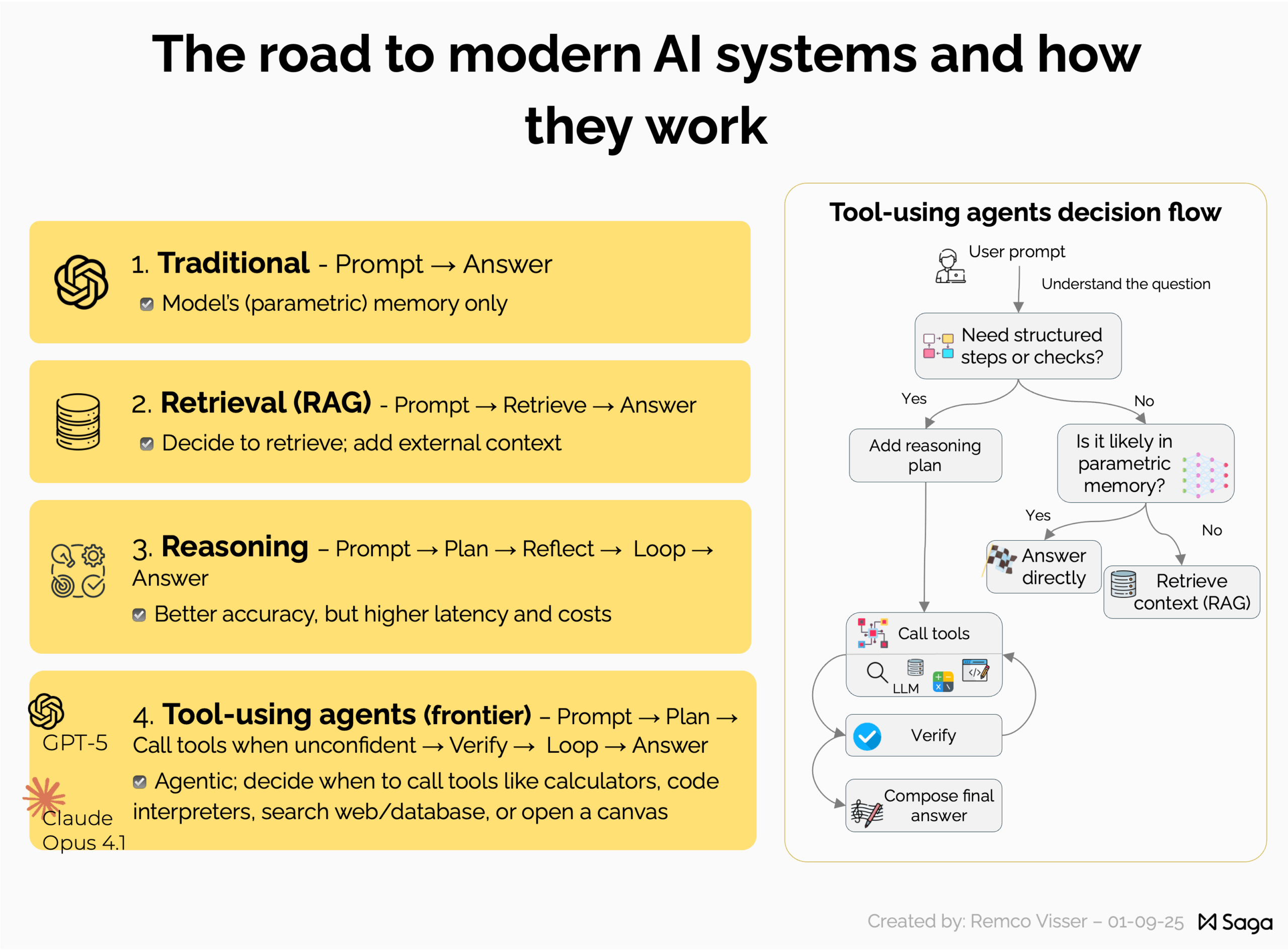
Saga is architected to work from context, from databases and attachments. Next to that, AI models are set to lower creativity settings to keep hallucinations to a minimum. Also, with reasoning models, Saga can analyze its own answer and double check whether something was hallucinated or not.
What kind of support does Saga provide?
All modern LLMs can hallucinate, but Saga mitigates this by
(i) using retrieval‑augmented generation (RAG) so the AI must base answers on supplied documents,
(ii) surfacing citations to the underlying text,
(iii) keeping a human lawyer in the loop for final review. The system is built to support professional judgment, not replace it.
How is client data protected?
Saga uses strict access controls, encryption in transit and at rest, audited infrastructure, and tenant isolation so that your matters remain confidential and segregated from other customers. You retain ownership and control of your data.
Is the system compliant with GDPR and the EU AI Act?
Saga is designed with GDPR principles in mind (lawfulness, purpose limitation, data minimisation, data subject rights) and is aligned with the EU AI Act’s requirements for high‑risk systems, including transparency, logging, and risk‑management processes. We provide documentation and DPAs to support your own compliance assessments.
Can Saga integrate with our DMS (iManage/ NetDocuments)?
Saga offers integrations and APIs to connect to leading DMS platforms (such as iManage, Epona365 and NetDocuments).
Does Saga work with our existing Microsoft environment (Teams, Office, Outlook)?
Yes. Saga is built to work alongside Microsoft 365, including Word (and soon Outlook), and can surface AI assistance where lawyers already draft and review, reducing application‑switching.